 QA
QA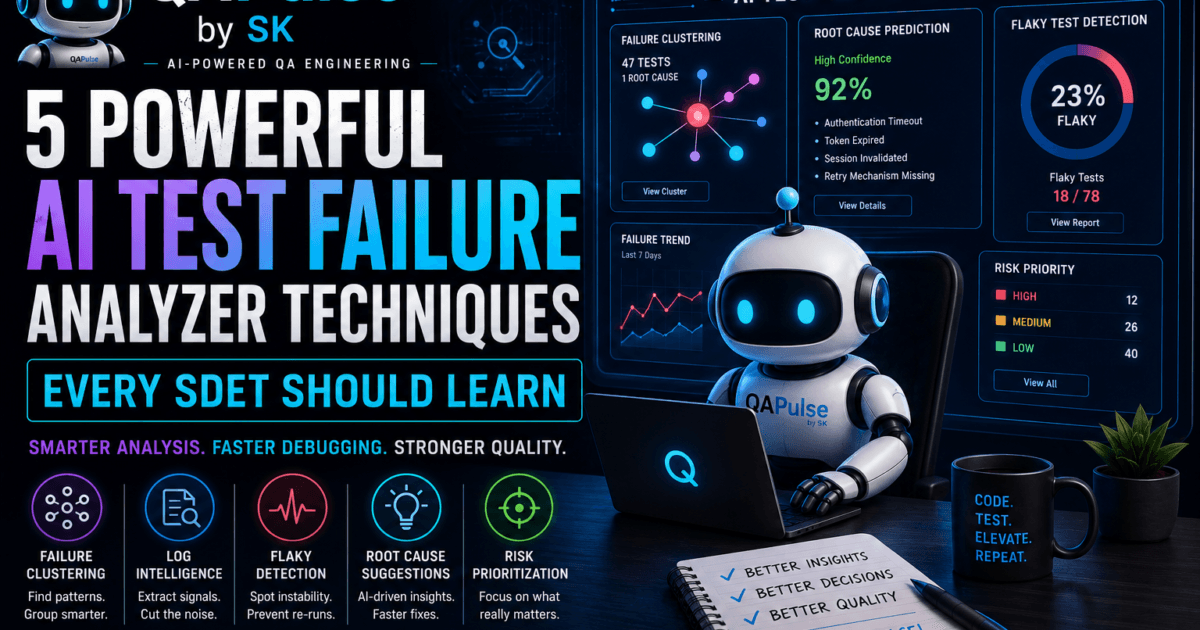
AI Test Failure Analyzer Systems Are Becoming Essential in 2026
Modern automation pipelines are generating more noise than ever.
Every failed pipeline now creates:
- screenshots
- logs
- stack traces
- videos
- network dumps
- console errors
- CI artifacts
And honestly?
Most teams still debug failures manually.
That no longer scales.
This is exactly why the rise of the AI test failure analyzer is becoming one of the biggest shifts in modern QA engineering.
Because modern automation systems need more than:
PASS / FAIL
They need:
✅ understanding
✅ pattern recognition
✅ root-cause analysis
✅ failure intelligence
Why Traditional Failure Debugging Is Breaking
Most QA workflows still look like this:
Test failed
→ Open screenshot
→ Open logs
→ Guess issue
→ Re-run pipeline
→ Hope it passes
That process becomes dangerous when:
- pipelines scale
- test count increases
- microservices multiply
- CI/CD becomes faster
- flaky failures explode
Eventually engineers spend more time:
❌ debugging automation
Than:
✅ validating software quality
That’s a major engineering bottleneck.
What is an AI Test Failure Analyzer?
An AI test failure analyzer is a system that intelligently processes:
- test failures
- logs
- traces
- screenshots
- runtime signals
- historical patterns
And then helps engineers:
- identify likely root causes
- detect flaky behavior
- cluster similar failures
- prioritize issues
- reduce debugging time
Instead of:
raw failure noise
You get:
actionable engineering intelligence
Huge difference.
AI Test Failure Analyzer Technique #1 — Failure Clustering
One of the biggest problems in automation:
100 failures ≠ 100 unique issues
Many failures originate from:
- one backend outage
- one authentication issue
- one dependency timeout
- one locator change
A strong AI test failure analyzer can cluster failures automatically.
Example:
{
  "cluster": "Authentication Timeout",
  "affected_tests": 47,
  "confidence": "92%"
}
Now engineers instantly understand:
👉 failure relationships
Instead of debugging endlessly.
AI Test Failure Analyzer Technique #2 — Log Intelligence
Most logs are overwhelming.
AI systems can intelligently extract:
- repeated patterns
- critical exceptions
- dependency failures
- timing anomalies
- environment instability
Example Python parser:
import re

def detect_auth_failure(log):
    pattern = r"401|Unauthorized|Token expired"

    if re.search(pattern, log):
        return "Authentication Failure"

    return "Unknown"

log = "API returned 401 Unauthorized"

print(detect_auth_failure(log))
Simple?
Yes.
Powerful?
Absolutely.
Because intelligent debugging starts with:
👉 signal extraction
AI Test Failure Analyzer Technique #3 — Flaky Pattern Detection
Flaky tests destroy trust in automation.
The dangerous part?
Most flaky patterns are invisible manually.
An AI test failure analyzer can detect:
✅ intermittent failures
✅ unstable environments
✅ timing inconsistencies
✅ browser-specific instability
✅ network randomness
Example logic:
if test.failed_last_5_runs and passed_today:
    mark_as_flaky()
Now imagine this combined with:
- ML pattern detection
- historical analytics
- runtime telemetry
That’s where modern QA is heading.
AI Test Failure Analyzer Technique #4 — Root Cause Suggestions
This is where AI becomes extremely useful.
Instead of:
Test Failed
The analyzer can suggest:
Possible Cause:
- Redis timeout spike
- Authentication token expiration
- Slow database query
- UI selector instability
That massively reduces:
✅ debugging time
✅ investigation fatigue
✅ pipeline recovery delays
Modern CI/CD increasingly requires:
👉 intelligent failure triage
Not manual guesswork.
AI Test Failure Analyzer Technique #5 — CI/CD Risk Prioritization
Not every failure matters equally.
This is critical.
Many teams waste time fixing:
❌ low-impact failures
While:
❌ production-critical risks remain unnoticed
An advanced AI test failure analyzer can prioritize failures using:
- historical severity
- user impact
- dependency criticality
- flaky probability
- production similarity
- runtime risk scoring
Example:
{
  "priority": "HIGH",
  "reason": "Payment flow instability detected"
}
That’s much smarter than:
Sort by timestampWhy AI Test Failure Analyzer Systems Matter in 2026
Modern systems are becoming:
- distributed
- AI-assisted
- event-driven
- continuously changing
Traditional debugging workflows cannot scale effectively anymore.
This is why intelligent QA systems increasingly require:
✅ observability
✅ telemetry
✅ AI reasoning
✅ runtime analytics
✅ adaptive debugging
The future of testing is:
👉 intelligent failure understanding
AI Test Failure Analyzer Architecture Example
A modern pipeline may look like:
CI/CD Pipeline
    ↓
Failure Collector
    ↓
Log Parser
    ↓
AI Analysis Engine
    ↓
Failure Clustering
    ↓
Root Cause Suggestions
    ↓
Slack/Jira Alerts
Now the automation system becomes:
✅ proactive
instead of:
❌ reactive
That’s a massive shift in QA engineering.
What Smart SDETs Should Learn Now
Modern QA engineers should increasingly understand:
- observability
- runtime telemetry
- AI workflows
- log intelligence
- system behavior
- pattern analysis
Because future automation systems will require:
👉 reasoning
Not only assertions.
Important Reality Check
Most teams still use:
manual debugging workflows from 2018
While software systems already evolved into:
AI-scale complexity
That gap is becoming dangerous.
Fast.
AI Test Failure Analyzer Systems Will Become Standard
Within the next few years:
AI-assisted debugging will likely become:
✅ normal
Just like:
- CI/CD
- cloud pipelines
- automated testing
- trace viewers
became normal previously.
The teams adopting intelligent failure analysis early will move much faster.
AI Test Failure Analyzer Benefits for Modern QA Teams
An AI test failure analyzer helps QA teams reduce debugging fatigue, identify flaky patterns faster, cluster related failures intelligently, and improve CI/CD reliability. Modern AI test failure analyzer systems use logs, telemetry, runtime signals, and historical execution patterns to provide actionable engineering insights. As software systems become more distributed and AI-driven, intelligent failure analysis is becoming essential for scalable automation and modern QA engineering workflows in 2026.
External Resources (DoFollow)
Let’s Talk
👉 Would you trust an AI test failure analyzer in production pipelines?
👉 What wastes the most debugging time in modern automation today?
Drop your thoughts below 👇
Follow for More
This article is part of QA Pulse by SK — focused on:
- AI Testing 🤖
- Modern QA Engineering 🧪
- Intelligent Automation ⚙️
- Future SDET Architecture 🚀
You can also explore:
Final Line
The future of QA will belong to systems that understand failures — not just report them.
More Relevant Articles
- The Most Dangerous QA Engineer in 2026 Is the Comfortable One
- Why Most Test Automation Frameworks Collapse at Scale
- Most QA Engineers Are Learning the Wrong Skills in 2026