 QA
QA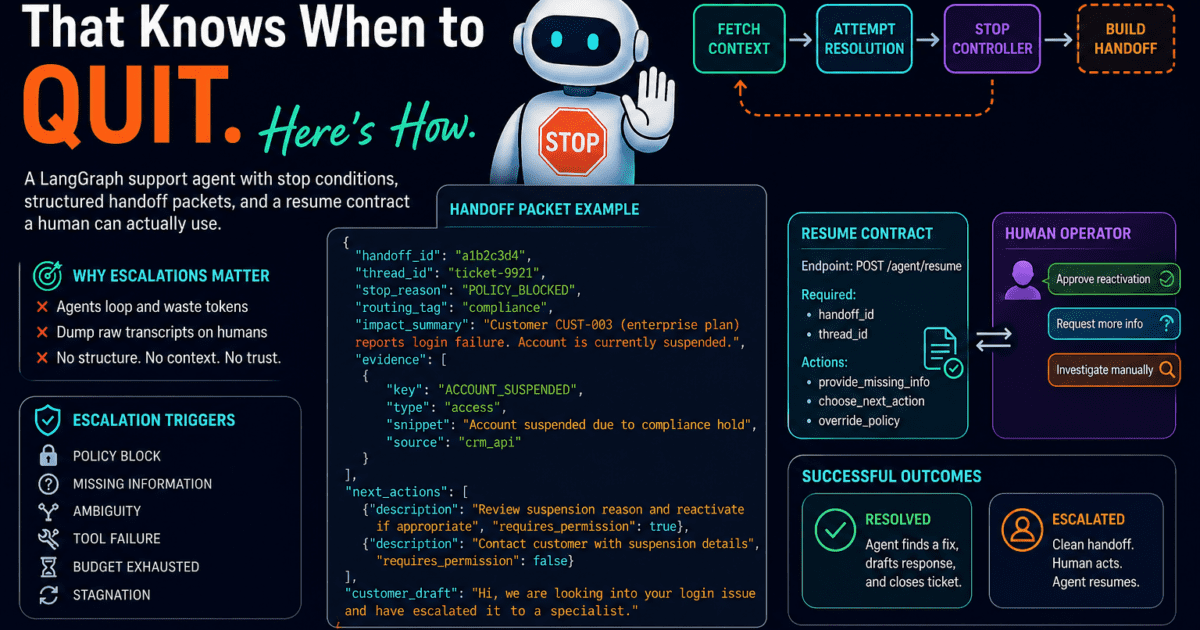
If you’ve ever built an AI agent…
You’ve probably seen this 👇
🤖 It retries endlessly
🤖 Calls the same failing API again and again
🤖 “Thinks”… but goes nowhere
And worst of all?
👉 It never knows when to stop
💥 The Hidden Problem Nobody Talks About
Most AI agents don’t fail because they’re dumb.
They fail because they don’t know when they’re stuck.
Instead of saying:
“I need help”
They:
- Loop forever 🔁
- Burn tokens 💸
- Confuse humans 🤯
- Dump logs instead of insights
That’s when I realized something powerful:
👉 Escalation is not failure. It’s architecture.
🚨 The Breakthrough: Teach Agents to Quit (Properly)
So I built something different.
Not just a smart agent…
But a disciplined agent that knows:
✔ When it’s blocked
✔ When it lacks permissions
✔ When data is missing
✔ When it’s wasting time
And most importantly:
👉 When to stop and hand over cleanly
🧠 The Shift: From “Trying Harder” → “Deciding Smarter”
Most systems do this:
Run → Fail → Retry → Retry → Retry → Panic
Mine does this:
Run → Analyze → Decide
↓
If blocked → STOP → ESCALATE → HANDOFF
That one decision layer changes everything.
🧩 What a Good AI Agent Does When It’s Stuck
Instead of chaos…
It produces a structured handoff packet:
- What happened
- Why it stopped
- What it tried
- What’s needed next
- Suggested actions
- Customer-safe response
👉 Humans get clarity. Not noise.
⚖️ Approvals vs Escalations (Critical Distinction)
Most teams get this wrong.
✅ Approval
Agent knows what to do → needs permission
“Should I execute this?”
🚨 Escalation
Agent doesn’t know what to do safely
“You need to take over”
Mix these up and you either:
- Spam humans 🤦♂️
- Or create unsafe automation 😬
🏗️ The Architecture (LangGraph Flow)
Fetch Context → Attempt Resolution → Stop Controller → Handoff Builder
Each piece has a strict responsibility.
🧠 1. Agent State (The System Contract)
This is the backbone of everything.
from typing import Annotated, TypedDict

def merge_evidence(existing: list[dict], new: list[dict]) -> list[dict]:
    evidence_by_key = {e["key"]: e for e in existing}
    for e in new:
        evidence_by_key[e["key"]] = e
    return list(evidence_by_key.values())

class AgentState(TypedDict):
    ticket: dict
    category: str
    account: dict | None

    evidence: Annotated[list[dict], merge_evidence]
    evidence_keys: list[str]

    step_count: int
    max_steps: int
    stagnation_count: int
    last_evidence_count: int

    outcome: str
    stop_reason: str | None
💡 Why this matters:
- Enables traceable reasoning
- Enables stagnation detection
- Keeps state lightweight + serializable
🔍 2. Attempt Resolution (Decision Engine)
This is where your agent decides:
👉 “Can I solve this — or should I stop?”
def attempt_resolution(state: AgentState) -> dict:
    if state.get("stop_reason"):
        return {}

    keys = state.get("evidence_keys", [])

    if "ACCOUNT_SUSPENDED" in keys:
        return {
            "stop_reason": "POLICY_BLOCKED",
            "step_count": state["step_count"] + 1
        }

    if "INVOICE_OVERDUE" in keys:
        return {
            "stop_reason": "POLICY_BLOCKED",
            "step_count": state["step_count"] + 1
        }

    return {
        "stop_reason": "MISSING_INFO",
        "step_count": state["step_count"] + 1
    }
👉 This is not testing logic.
👉 This is decision architecture.
🚦 3. Stop Controller (The Real Brain)
Most AI systems fail here.
This is what prevents infinite loops.
def stop_controller(state: AgentState) -> dict:
    step = state.get("step_count", 0)

    if step >= state.get("max_steps", 15):
        return {"stop_reason": "BUDGET_EXCEEDED"}

    curr_key_count = len(state.get("evidence_keys", []))
    last_key_count = state.get("last_evidence_count", 0)

    stag = state.get("stagnation_count", 0)

    if curr_key_count == last_key_count:
        stag += 1
    else:
        stag = 0

    if stag >= 3:
        return {"stop_reason": "STAGNATION"}

    return {
        "stagnation_count": stag,
        "last_evidence_count": curr_key_count
    }
💡 This enables:
- Loop detection
- Budget control
- Intelligent stopping
🚨 Escalation Triggers (Real-World Logic)
Your agent must recognize failure modes:
- 🔒 Policy Block
- ❓ Missing Information
- 🤯 Ambiguity
- 🔧 Tool Failure
- ⏳ Budget Exhausted
- 🔁 Stagnation
👉 This is what separates demos from production systems.
📦 4. Handoff Packet (Your Killer Feature 🔥)
When escalation happens:
👉 The agent packages everything cleanly
def build_handoff(state: AgentState) -> dict:
    return {
        "handoff_id": "generated_id",
        "thread_id": state["thread_id"],
        "stop_reason": state.get("stop_reason"),
        "routing_tag": "compliance",
        "impact_summary": "Customer issue detected",
        "evidence": state.get("evidence", []),
        "next_actions": [
            {"description": "Investigate manually", "requires_permission": False}
        ],
        "customer_draft": "Hi, we are looking into your issue."
    }
💡 Result:
- No raw logs
- No confusion
- Just actionable insight
🔄 5. Resume Contract (Where Most Systems Fail)
This is what makes your system next-level.
The agent doesn’t restart blindly.
👉 It resumes with context.
def resume_from_packet(graph, thread_id: str, human_input: str):
    config = {"configurable": {"thread_id": thread_id}}

    current_state = graph.get_state(config)

    update_data = {
        "stop_reason": None,
        "outcome": "running",
        "resume_input": {"payload": human_input}
    }

    graph.update_state(config, update_data)

    return graph.invoke(None, config)
💡 This enables:
- Human + AI collaboration
- No lost context
- Faster resolutions
⚔️ Real Scenario
Customer:
“I can’t log in”
System finds:
👉 Account is suspended
❌ Typical Agent
- Retries login
- Blames system
- Confuses user
✅ This Agent
- Detects suspension
- Recognizes policy block
- Stops immediately
- Escalates with context
👉 That’s the difference between:
Automation vs Engineering
🔐 Production Reality (What Most Blogs Skip)
You must handle:
🧑🤝🧑 Concurrency
Multiple humans clicking “resume”
→ Use idempotency keys
⏱️ Stale Data
Ticket updated after escalation
→ Reject outdated actions
🔌 System Failures
APIs down
→ Escalate intelligently
👉 This is where real systems break.
📈 Real Impact
After implementing this:
🔻 Reduced agent loops
💸 Lower token costs
🚀 Faster resolutions
😌 Happier support teams
And most importantly:
👉 Humans get answers — not logs
🧠 The Big Insight
You don’t need an agent that solves everything.
You need an agent that:
✔ Solves what it can
✔ Stops when it should
✔ Explains clearly
✔ Hands off cleanly
🎯 Final Thought
Everyone is trying to build:
🤖 “Smarter agents”
But the real unlock is:
👉 More disciplined agents
Because in real systems…
Knowing when to stop
is more valuable than trying forever.