 QA
QA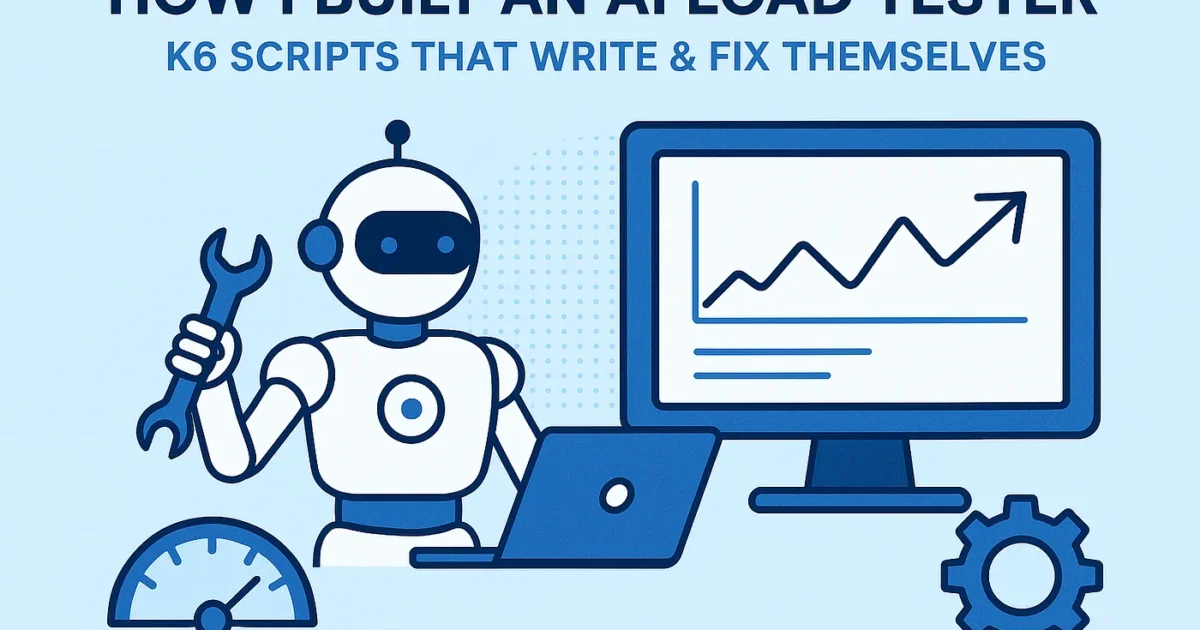
🤖💥 The Future of Performance Testing Is… Self-Healing?
Let me tell you a story.
A few months ago, my k6 scripts were acting like toddlers — breaking for the smallest reason and refusing to scale without crying.
Then one day I asked myself:
“Why am I the only one writing and fixing load test scripts? Why can’t the scripts write and fix themselves?”
That’s when the idea hit me like a race condition at production traffic:
💡 What if I pair k6 with an LLM and build an AI-powered load tester that:
- writes the initial load test script
- detects abnormalities in metrics
- rewrites scenarios automatically
- and explains failures like a senior SRE doing a postmortem?
Yes… the k6 script becomes self-healing.
Let’s break it down. 👇
🔥 1. Why Self-Healing Load Tests?
Traditional load testing has a huge flaw:
You write static scripts, but your app is dynamic.
Endpoints change, payloads change, authentication expires, traffic patterns shift.
Your script?
Sits there like:
“If the response code isn’t 200… I throw an error. Not my problem.”
What if a load test could adapt?
What if it could detect real user patterns, rewrite itself, re-run, and deliver a full AI-generated SRE-style root cause report?
Welcome to 2025+ load testing.
Welcome to agentic performance testing.
⚙️ 2. Architecture: k6 + AI = Autonomous Load Tester
Here’s the blueprint I built:
User runs → k6 test
           ↓
LLM analyzes:
- metrics (latency, p95, p99, RPS)
- errors & logs
- code inefficiencies
           ↓
LLM rewrites the k6 script:
- adjusts VUs & ramping stages
- updates payloads & endpoints
- fixes failed validation logic
           ↓
LLM generates SRE-style explanation
           ↓
Re-runs the updated script
Think of it like GitHub Copilot, but for load testing.
Except it keeps testing until the script stabilizes.
Zero ego. No weekends. No burnout. 😎
🧠 3. Step 1 — LLM Writes the First k6 Script
You simply tell it:
“Simulate 2,000 virtual users hitting /checkout with random user IDs.”
The LLM generates:
import http from 'k6/http';
import { sleep, check } from 'k6';


export let options = {
  stages: [
    { duration: '10s', target: 200 },
    { duration: '20s', target: 2000 },
    { duration: '10s', target: 0 },
  ],
};
export default function () {
  const userId = Math.floor(Math.random() * 10000);
  const res = http.get(`https://api.example.com/checkout/${userId}`);
  check(res, {
    'status is 200': (r) => r.status === 200
  });
  sleep(1);
}
Boom.
First script: done.
No copy-paste from the docs. No boilerplate.
🧪 4. Step 2 — AI Detects Failures Dynamically
After the run, the AI consumes:
- summary JSON
- p95, p99 spikes
- HTTP error breakdown
- failed checks
- any anomalies like throughput drops or broken ramp-up
Example error detected:
❌ 32% of requests failed with HTTP 429 (rate limited)
Traditional loader:
“Test failed.”
AI loader:
“Got it. Let me fix it.”
🔧 5. Step 3 — AI Rewrites the Script Automatically
The LLM adjusts ramping, retry logic, thresholds, or payload issues.
Example rewrite:
Before:
stages: [
  { duration: '20s', target: 2000 }
]
After AI correction:
stages: [
  { duration: '30s', target: 1500 },
  { duration: '1m', target: 2000 },
  { duration: '20s', target: 0 }
],
rps: 800
And adds intelligent retry logic:
let retries = 3;
while (retries > 0 && res.status === 429) {
  sleep(0.5);
  res = http.get(url);
  retries--;
}
It fixed the script.
It stabilized the test.
It learned.
🔍 6. Step 4 — AI Explains the Root Cause Like a Senior SRE
After every iteration, I get a beautiful reasoning report:
📝 AI-Generated Root Cause Summary
- The API starts rate-limiting at >900 RPS
- CPU usage spikes → 92% at p99
- Garbage collection pauses observed every ~300ms
- k6 script lacked retry + too aggressive ramp-up
- Recommended increasing warm-up stages and lowering RPS ceiling
That’s not a “test result.”
That’s a mini postmortem.
No junior QA could write that.
Only an LLM powered by metric context can.
♻️ 7. Step 5 — It Repeats Until Stable
Run → Detect → Fix → Re-Run → Explain → Repeat
The loop continues until:
“All thresholds satisfied. Test stabilized.”
Your k6 script becomes a living organism.
🧩 8. What This Solves
✔ No more manually rewriting load tests
✔ AI learns your API behavior across runs
✔ Automatic detection of performance regressions
✔ Smart adjustments to ramp-up, RPS, and think-time
✔ Root cause detection without dashboards
✔ Works for microservices & distributed systems
✔ Perfect for SRE teams running chaos or spike tests
This is not “AI assistance.”
This is AI ownership.
🛠️ 9. Tools You Need to Build This
- k6 → load engine
- LLM (GPT-4.1 / GPT-5) → reasoning engine
- JSON summary from k6 → metrics feed
- Autogen / LangGraph / CrewAI → multi-agent loop
- Prometheus or InfluxDB (optional) → deeper metric signals
- Code interpreter agent → for script regeneration
You can literally build a PoC in a weekend.
🚀 10. The Future: Autonomous Performance Engineers
We’re moving from:
❌ “Testers who write scripts”
to
✔ “Agents who generate and improve scripts automatically”
Your job shifts to:
- monitoring
- validating
- orchestrating automated test intelligence
This is not the end of performance testers.
It’s the beginning of Performance Testers 2.0.
🎯 Final Thought
If your load tests are still static in 2025, you’re testing the past — not the present.
AI won’t just assist load testing.
It will become the load tester.
And honestly?
That’s the best teammate I’ve ever had.