 QA
QA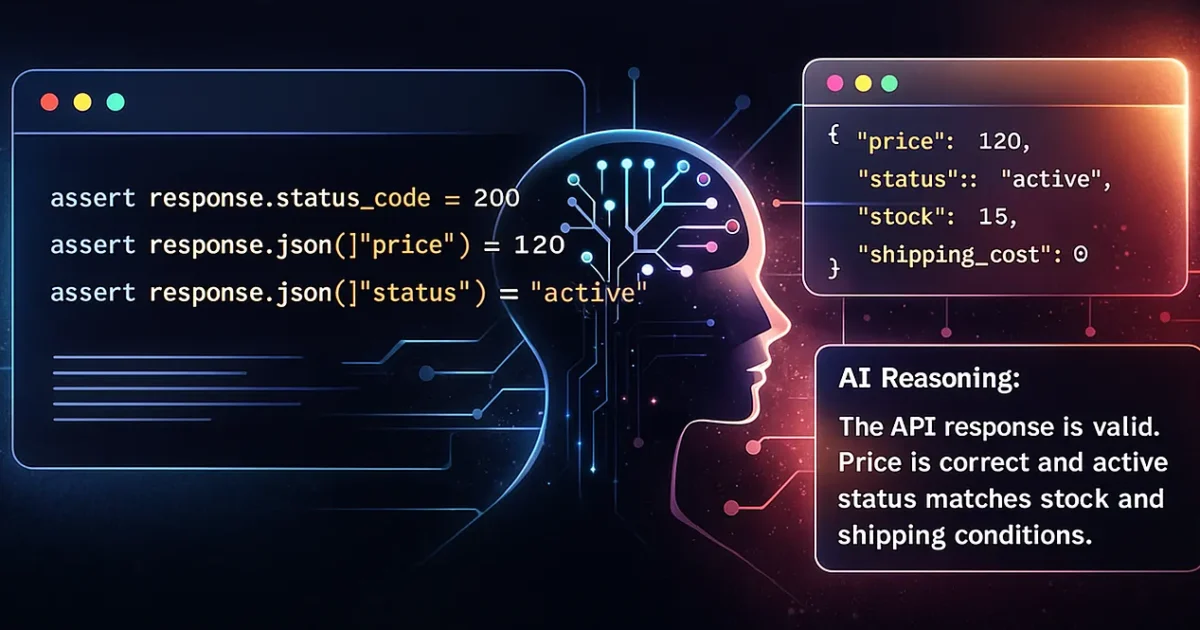
Software testing is undergoing a fundamental shift.
For years, QA engineers relied on hardcoded assertions to validate API responses. It worked well when systems were simple and predictable.
But modern APIs are no longer static.
They are dynamic, context-aware, and often influenced by AI-driven logic.
And that’s exactly why traditional assertions are starting to break down.
The Problem with Hardcoded Assertions
A typical API test still looks like this:
assert response.status_code == 200
assert response.json()["price"] == 120
assert response.json()["status"] == "active"
Clean. Simple. Easy to read.
But also fragile.
Why?
Because these assertions assume:
- Fixed values
- Stable business rules
- Predictable responses
None of which are guaranteed anymore.
Why Static Checks No Longer Work in Modern Systems
1. Business Logic Changes Frequently
Small updates can break hundreds of tests.
Example:
- Pricing logic updated
- New optional fields introduced
- Status transitions modified
Your tests fail—not because the API is wrong, but because your expectations are outdated.
2. Lack of Context Awareness
Consider this response:
{ "status": "pending_verification" }
A static assertion expecting "active" will fail.
But in reality:
- The user may be in a valid onboarding flow
- KYC verification may be in progress
The system is correct.
The test is wrong.
3. High Maintenance Overhead
Hardcoded assertions lead to:
- Large test files
- Frequent updates
- Repetitive changes across multiple tests
Every business change = multiple commits and rework.
4. Inability to Detect Behavioral Issues
Static assertions validate values, not logic.
They cannot detect:
- Logical inconsistencies
- Invalid state transitions
- Unexpected side effects
- Semantic violations (e.g., negative pricing)
They check data correctness, not behavior correctness.
Enter AI Reasoning-Based Validation
This is where things change.
Instead of validating fixed values, AI validates intent and behavior.
Using an LLM-powered validator, your test becomes:
reasoning = llm.reason(
    expected_behavior="""
    Price must always be >= 0.
    If user is premium, shipping_cost = 0.
    Stock cannot be negative.
    Status should match inventory conditions.
    """,
    actual_response=response.json()
)

assert reasoning.is_valid
print(reasoning.explanation)
What This Looks Like in Practice
When Everything Is Correct
AI Reasoning:
The API response is valid.
User is premium, so shipping_cost = 0 is correct.
Price and stock are within expected ranges.
Status matches inventory rules.
When a Bug Exists
AI Reasoning:
Stock is -2 which violates the rule: "Stock cannot be negative."
All other fields are valid.
What AI Reasoning Adds That Assertions Cannot
Contextual Understanding
AI interprets rules like:
“If order is delivered, delivery_date must exist.”
This goes beyond simple equality checks.
Dynamic Validation
Instead of comparing fixed values, AI:
- Reads the rules
- Reads the response
- Evaluates correctness
Human-Readable Explanations
Instead of:
AssertionError: expected 200 but got 202
You get:
202 Accepted is valid because the operation is asynchronous.
Adaptability to Change
Update the rule once:
Usage limit for premium users = 150
All tests adapt automatically.
No need to rewrite assertions.
Detection of Hidden Issues
AI can identify:
- Missing required fields
- Contradictory states
- Unexpected new fields
- Invalid enum transitions
- Illogical timestamps
This is semantic validation, not just syntactic checking.
Real Comparison: Old vs New Approach
Traditional Assertions
assert response.json()["status"] == "active"
assert response.json()["plan"] == "premium"
assert response.json()["usage"] <= 100
AI Reasoning-Based Validation
rules = """
If user is premium:
    - Status must be active or trialing
    - Usage limit is 150
    - Suspended accounts cannot have premium active
"""

reasoning = llm.validate(rules, response.json())

assert reasoning.pass
print(reasoning.explanation)
Why This Matters for QA Teams
Reduced Maintenance
Up to 70% fewer updates when business logic changes.
Increased Coverage
AI validates more scenarios than explicitly written tests.
Smarter Test Suites
Fewer tests, but deeper validation.
Better Bug Detection
AI catches:
- Logical contradictions
- Behavioral anomalies
- Edge cases humans often miss
How to Implement This in Your Framework
Step 1: Centralize Business Rules
Store rules in:
- YAML
- Markdown
- Vector databases
Step 2: Create an AI Validation Layer
def ai_assert(rules, response):
    return llm.validate(rules, response)
Step 3: Replace Static Assertions
Move from:
assert response.json()["status"] == "active"
To:
assert ai_assert(rules, response.json()).pass
Final Thoughts
Static assertions were built for a simpler era.
Today’s APIs:
- Personalize responses
- Adapt to user behavior
- Evolve continuously
Testing must evolve too.
This is not just automation anymore.
This is reasoning-driven quality engineering.
More Relevant Articles
- The Self-Healing Load Test: How k6 + AI Auto-Tunes Thresholds & Fixes Performance Regressions
- Load Testing Microservices with AI Personas: k6 + LLM-Generated User Journeys
- How I Built a Postman Bot That Detects Breaking API Changes Before Deployment (Using LLM)