If you still believe:
“QA equals writing Selenium scripts”
then you are already behind the current shift in the industry.
Quality Assurance is no longer just about testing software. It is evolving into a multidisciplinary engineering role driven by AI, automation, and data.
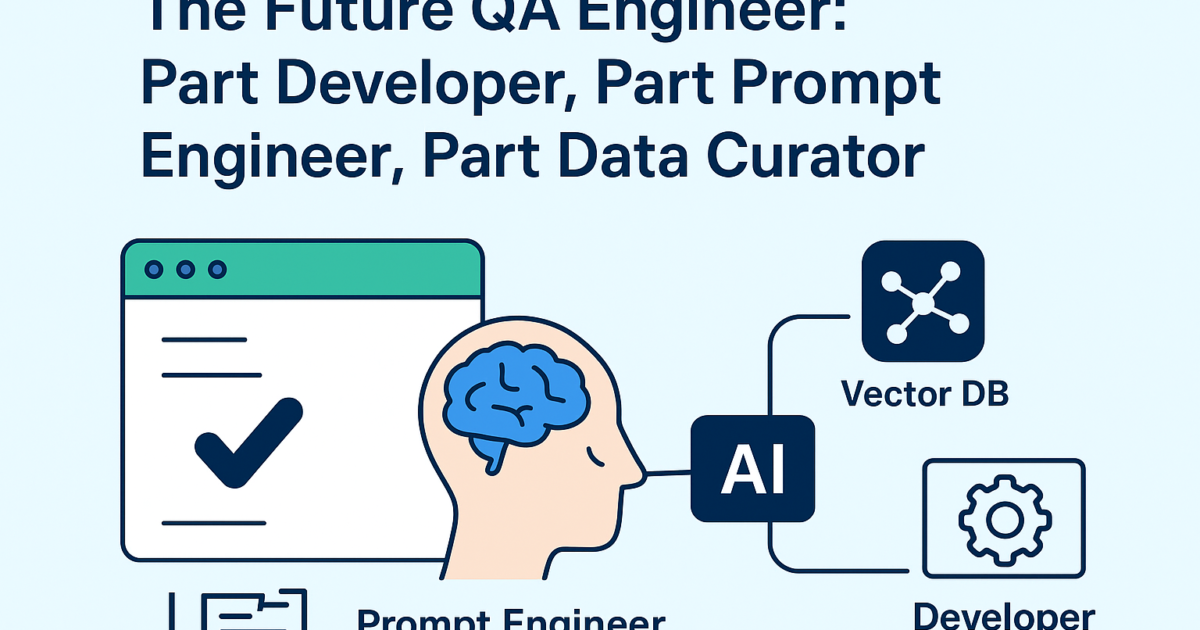
The modern QA engineer is becoming a hybrid professional combining:
- Developer
- Prompt Engineer
- Data Curator
- AI Orchestrator
- Risk Analyst
We are entering the era of AI-Augmented Quality Engineering, where AI can generate test cases in seconds, but humans define what truly matters.
1. QA as a Developer Role
Modern QA engineers must think like developers, but not in the traditional sense of writing long Selenium scripts.
The focus has shifted from script writing to system building.
Key responsibilities include:
- Building AI-driven testing agents
- Designing automated test pipelines
- Debugging backend and API-level issues
- Integrating tests into CI/CD workflows
Example:
A Python-based test agent can:
- Read Jira tickets
- Generate test cases automatically
- Execute API/UI tests
- Return structured reports to Slack or dashboards
Required technical skills:
- Python or TypeScript
- REST and GraphQL APIs
- Docker basics
- CI/CD tools like Jenkins or GitHub Actions
2. QA as a Prompt Engineer
In the AI era, QA engineers no longer write every test manually. Instead, they guide AI systems to generate and validate them.
Prompt engineering in QA is not about writing simple instructions. It is about designing structured test intelligence.
Key areas include:
- Structured test generation prompts
- AI-driven validation logic
- Multi-agent testing workflows
- Negative and edge-case generation
Example use case:
Instead of writing test cases manually, you define:
Generate boundary test cases using API schema and production error logs.
The AI handles execution logic, while QA defines intent and coverage.
This shifts QA from execution to orchestration of intelligence.
3. QA as a Data Curator
In AI-powered systems, data quality directly impacts testing quality.
QA engineers are now responsible for curating and maintaining test intelligence data.
Responsibilities include:
- Managing structured test datasets
- Storing API requests, logs, and bug history
- Organizing user behavior patterns
- Ensuring compliance with data regulations
Why it matters:
Modern LLM-based testing systems rely heavily on historical data. Poor data leads to poor test generation.
QA becomes the gatekeeper of reliable test intelligence.
4. QA as an AI Orchestrator
The next evolution of QA is not execution but orchestration.
Instead of running tests manually or even writing scripts, QA engineers design systems that manage testing autonomously.
This includes:
- AI-driven regression execution
- Self-healing test frameworks
- Multi-agent test systems (generator, executor, analyzer)
- Real-time risk-based test selection
Key shift:
You are no longer writing tests inside a framework.
You are designing the framework itself.
5. QA as a Risk Analyst
AI can generate thousands of test cases, but it cannot understand business impact.
That responsibility belongs to QA engineers.
Core responsibilities:
- Identifying high-risk product areas
- Prioritizing test coverage based on business impact
- Detecting failure scenarios that affect users
- Evaluating AI-generated output reliability
- Deciding what should NOT be tested
Key insight:
AI handles volume. Humans handle judgment.
This is where QA remains irreplaceable.
What the Future QA Engineer Looks Like
A future QA engineer is not defined by a single skill.
They are a combination of:
- Software engineer
- AI system operator
- Data strategist
- Product risk analyst
This is not an upgrade of QA.
It is a complete transformation of the role.
How to Become a Future QA Engineer
1. Learn a core programming language
Focus on Python or TypeScript.
2. Master API testing
Understand REST, GraphQL, and backend systems deeply.
3. Learn prompt engineering for QA
Focus on:
- Test generation
- Scenario expansion
- AI validation techniques
4. Understand vector databases and RAG systems
Tools like Pinecone or Chroma are becoming essential.
5. Build AI-driven testing projects
Even small agents that automate testing workflows are valuable.
6. Specialize in one direction
Examples:
- AI test automation
- LLM validation systems
- Autonomous QA agents
- Data-driven testing frameworks
7. Build a public portfolio
Use platforms like your blog on www.skakarh.com to document your work.
Final Thoughts
AI is not replacing QA engineers.
It is redefining the role into something far more strategic and powerful.
The real question is no longer:
Will AI replace QA?
It is:
Will you evolve fast enough to design the systems that control AI?
Those who adapt will not just survive this shift.
They will lead it.
